
Nick Dyrenfurth
Executive Director of the John Curtin Research Centre
My old boss Bill Shorten used to invoke the 90:10 rule: start with the 90 per cent we agree on, not the 10 per cent where we differ. It echoed Bob Hawke’s consensus approach – prioritising the art of persuasion, goodwill and compromise, and never making perfection the enemy of the good – but also reflected Shorten’s leadership style.
The furious debate over the Albanese government’s proposed hate laws shows how far we have drifted from the days of Hawke. Not because Australians disagree about fundamentals – most don’t – but because political culture now rewards the opposite of consensus: maximalism, suspicion and the demand for instant, total resolution of complex moral, social and legal questions. Strip away the legal technicalities and the hate-laws fight is not really about one bill. It is about temperament and democratic decision-making.
Machiavelli had a subtler counsel: prudence. He warned rulers that timing matters, that acting under the pressure of public fury can be as dangerous as failing to act at all. Leaders are judged not by intention but by consequence. In modern politics, prudence has been rebranded as hesitation; hesitation as cowardice. The result is a permanent Goldilocks trap. Governments are always too slow, then they move, at which point they are too rushed.
Opposition Leader Sussan Ley has played this perfectly. First the government was accused of dragging its feet in not recalling parliament before Christmas; then of reckless haste in seeking to legislate through parliamentary process – exposure drafts, committee scrutiny, amendments and debate in a recalled parliament next week.
Both claims cannot be true but both are politically expedient. Ley complains that the Prime Minister is acting with politics in mind while simultaneously offering a politicised “alternative” package of reforms, serving to keep the divided Coalition together and with it, her leadership. Physician, heal thyself.
There is also a deeper layer of Coalition hypocrisy. The same people posturing as guardians against legislative haste and overreach after 15 people were murdered on Australian soil comfortably did that during the 2001 Tampa affair – excising large parts of maritime territory from the migration zone, rushing through retroactive legislation (with less than 24 hours’ notice) and making false claims about asylum-seekers throwing their own children overboard. The prudence of a decent man – Labor leader Kim Beazley – was ignored and he was publicly trashed for it.
Yet this habit is not confined to Coalition talking points. Jewish, Islamic and Christian leaders have all made separate claims, often from genuine experiences of fear, vulnerability and goodwill. That is understandable, particularly in the former case. But a tolerant, pluralist democracy can’t operate on the principle that each community’s needs constitute a veto or a timetable for the whole nation. Moral urgency does not dissolve the need for trade-offs; it sharpens it. Nor can it substitute for enforcing existing law.
Progressive critics have not urged haste so much as lurched between extremes. On one day, no new laws – because Jews, sorry “Zionists”, do not deserve protection, or because free speech is absolute. The next day, a politics of maximalist moral emergency, with the state summoned as enforcer, extending to new claims seeking to punish Islamophobia and stronger protections for LGBTIQ citizens.
You cannot relativise or deny anti-Semitism for years, carry on about complicity in a “genocide” while allying yourself with those demonising Jews, only to suddenly become guardians of civic virtue. Yet we witness Mehreen Faruqi insisting the Greens oppose the laws in the name of “political, civil and human rights”, listing everyone from queer people to Muslim women to Jewish men in kippahs (someone needs to tell the senator that most Jews don’t wear kippot; some women in my shul do, however), in a telling identity-politics manoeuvre. The cancer of anti-Semitism, even after Bondi’s horror, is rhetorically redistributed until it is about everyone except Jews, and Faruqi’s colleague David Shoebridge, with a straight face, can denounce the proposed laws as “scapegoating migrants” – a claim untethered from context or reality.
Worse, much of the former rhetoric is marinated in tropes with a long and ugly pedigree. Talk of shadowy Jewish influence, of disproportionate power, of “tentacles” shaping laws, is not new. It echoes the conspiracism of tsarist Russia, the racial pathology of Nazi Germany and the Stalinist fantasy of the Doctors’ Plot. That some on the ultra-left deploy these ideas without apparent self-awareness does not make them less toxic; it makes them more so.
The same incoherence was on display in the risible opposition to the inclusion of gun-related provisions, with former Nationals leader Michael McCormack reaching for National Rifle Association-style rhetoric about personal responsibility – the tired claim of “guns don’t kill people, people do”. Australians settled this argument decades ago. We chose laws and collective restraint over American slogans. To pretend otherwise is not conservative; it’s unserious.
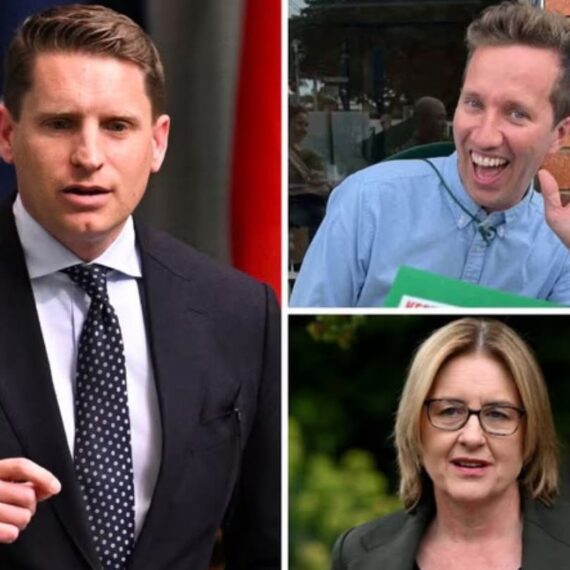
Andrew Hastie’s intervention flagging his opposition to the hate laws exposes a different contradiction. You cannot present yourself as a Burkean conservative – sceptical of abstraction, cognisant of human nature’s frailty and restraining role of institutions, respectful of social order – while recruiting libertarian arguments about freedom of speech. Burkean conservatism rests on prudence, restraint and parliament as the central actor. Libertarianism rests on the sovereign individual. You have to choose. In any case, Burke argued that radical reform could be undertaken in the context of “a grave and overruling necessity”.
All politicians can learn from Burke: “Wise men will apply their remedies to vices, not to names; to the causes of evil which are permanent, not the occasional organs by which they act, and the transitory modes in which they appear.”
This means confronting enduring anti-Semitic ideologies, from Islamist extremism to neo-Nazism, aimed at Jewish and non-Jewish Australians alike, by targeting their permanent causes and carriers – fundamentalist religious interpretation, hate preachers and organised extremist movements such as Hizb ut-Tahrir – rather than treating episodic outbreaks as the sum of the problem. Anti-Semitism does not care whether it dresses itself in religious absolutism or racial pseudoscience and neither should the state or Labor’s opponents.
The Institute of Public Affairs says the immigration debate could be “captured” and silenced, but this confuses disagreement with prohibition. Australia has fought endlessly over immigration under much heavier legal regimes. Debate did not disappear. The Centre for Independent Studies’ Peter Kurti warns of “blasphemy laws” brought in via the back door. No one is being asked to worship differently, only to accept that invoking religion does not confer a licence to vilify or intimidate others in a plural democracy.
What unites the bill’s otherwise opposed critics is a shared impatience, maximalism and opportunism. Everyone wants recognition now; clarity now; victory now. But democratic legitimacy is not produced by volume or velocity. This is where the 90:10 rule matters. The law of unintended consequences applies to everyone.
There is, in fact, overwhelming agreement across Australian society on the core 90 per cent: violence, threats, intimidation and harassment are wrong; Aussie Jews deserve protection; social cohesion matters; the law must be applied evenly. The key is the 10 per cent – thresholds, scope, safeguards – which is the hard work of legislating in a plural society.
The tragedy of the debate is that instead of doing that work, much of our political class prefers to litigate motives. To treat disagreement as evidence of immorality. We have replaced persuasion with prosecution, culturally as much as legally. My own Jewish community is not exempt from this dynamic. Understandable anger at our treatment these past two years, and failure to listen to our pleas for action, culminating in Bondi’s horror, and our legitimate, ongoing fears, has the potential to slide into maximalism.
I am sceptical of religious-text exemptions, but my stream of Judaism has never been much interested in literal readings or pulpit preachings of the more uncomfortable sections of Leviticus. We ought to think carefully about exempting good-faith public discussion or education. But my interest is not in adjudicating theology but in securing the 90 per cent: how people of different faiths, or none, can live together under the same law.
Parliament exists to manage these disagreements. It is not a nuisance to be circumvented; it is the sovereign maker of law. Its job is to debate, scrutinise, amend and act – slowly enough to think, quickly enough to govern. Hawke understood this. So, here’s a modest proposal, radical in today’s climate: everyone needs an Iced VoVo and a cup of tea. Stop demanding perfection on a deadline set by outrage. If Australia cannot still do 90:10 politics, no hate law, however well-intentioned, will deliver the cohesion everyone claims to want.